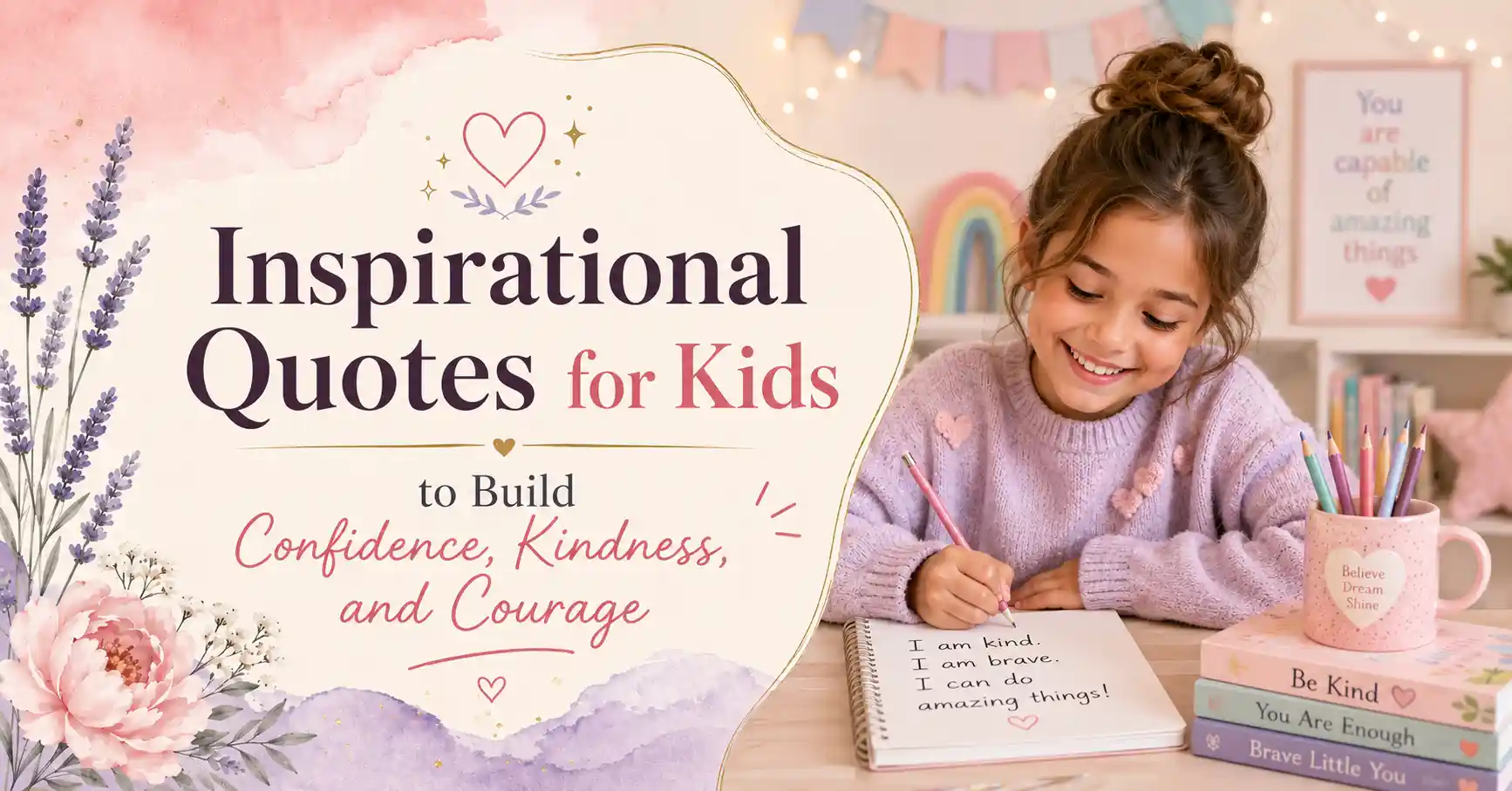
Inspirational quotes for kids can do more than decorate a classroom wall. The right words can help children feel brave before a test, calmer after a mistake, kinder with friends, and more hopeful during hard days. Parents, teachers, coaches, and caregivers often use short positive sayings because children remember simple messages easily.
In practice, these quotes work best when they are paired with real encouragement. A child does not only need to hear “You can do it.” They also need support, patience, and clear next steps. That is why this guide includes original quotes, positive affirmations, classroom ideas, growth mindset reminders, kindness messages, and practical tips for using them at home or school.
Use these inspirational quotes for kids in lunch notes, morning routines, reading corners, sports bags, homeschool lessons, birthday cards, classroom boards, and bedtime conversations.
Quick Answer
Inspirational quotes for kids are short, positive sayings that encourage confidence, kindness, courage, learning, and resilience. The best inspirational quotes for kids are simple, age-appropriate, and easy to repeat. They work best when adults use them with warmth, specific praise, and real support.
Why Inspirational Quotes Matter for Kids
Positive words help children build a healthy inner voice. When kids hear steady encouragement, they often feel safer trying new things, asking questions, and learning from mistakes.
This does not mean quotes can replace parenting, teaching, or emotional support. A quote is a tool. It works best when it starts a helpful conversation.
Stanford Teaching Commons explains growth mindset as the belief that intelligence and ability can develop, while also noting that growth mindset should not be reduced to effort alone. Children also need strategies, feedback, and support.
How can encouraging words support children?
Encouraging words can help children:
• Feel seen and valued
• Try again after mistakes
• Build confidence through practice
• Treat others with kindness
• Understand that learning takes time
• Calm down during stressful moments
• Speak to themselves with more patience
• Believe their choices matter
Positive parenting resources from the CDC also organize guidance by child development stage, which is useful because children need different kinds of support at different ages.
Best Inspirational Quotes for Kids by Situation
Different moments need different words. A child struggling with homework may need a growth mindset quote. A child feeling left out may need a kindness or confidence quote. A child preparing for a game may need courage.
| Situation | Best Quote Type | Example Use |
| Before school | Confidence quotes | Morning routine or lunch note |
| During homework | Growth mindset quotes | Study desk or planner |
| After a mistake | Resilience quotes | Calm conversation |
| Before a game | Courage quotes | Sports bag note |
| Classroom behavior | Kindness quotes | Bulletin board |
| Friendship problems | Empathy quotes | Group discussion |
| Bedtime worries | Calm affirmations | Night routine |
| Big goals | Dream big quotes | Vision board or journal |
Short Inspirational Quotes for Kids
Short quotes are easy for children to remember. These work well for younger kids, classroom posters, lunchbox notes, and quick morning reminders.
• You are growing every day.
• Small steps still move you forward.
• Your effort matters.
• Keep trying with a brave heart.
• You can learn hard things.
• Your ideas are worth sharing.
• Kindness makes you strong.
• Mistakes help your brain grow.
• Today is a fresh start.
• You are more capable than you think.
• Good choices build strong habits.
• Your voice matters.
• Try once more with patience.
• You bring light to this day.
• Believe in your next step.
What makes a quote easy for kids to remember?
A good quote for children is short, clear, and specific. It should use words they understand. It should also focus on action, not pressure. “Keep trying with patience” is more useful than “You must always win.”
Motivational Quotes for Students
Students need motivation for homework, reading, tests, projects, and classroom routines. These motivational quotes for students focus on effort, focus, curiosity, and steady improvement.
• Learning today helps tomorrow feel brighter.
• Great students ask brave questions.
• Practice turns confusion into confidence.
• A focused mind can do amazing things.
• Hard work opens new doors.
• Reading helps your imagination grow.
• Every lesson teaches something useful.
• Your best effort is always worth it.
• School is a place to grow, not to be perfect.
• Stay curious and keep exploring.
• Good habits make learning easier.
• One page at a time still counts.
• A mistake is not the end of the lesson.
• You can improve with practice and patience.
• Every question is a step toward understanding.
How can teachers use student quotes in class?
Teachers can use one quote as a daily focus. Read it aloud, ask students what it means, and connect it to a real classroom action. For example, after sharing “Practice turns confusion into confidence,” ask students to name one skill they improved through practice.
Growth Mindset Quotes for Kids
Growth mindset quotes help children understand that skills can improve. These quotes are useful for math, reading, sports, music, art, and problem-solving.
• Progress matters more than perfect results.
• Your brain grows when you keep learning.
• Try a new strategy when the first one fails.
• Every challenge can teach you something.
• Practice is how strong skills are built.
• You are not stuck; you are still learning.
• Mistakes show where growth can begin.
• Keep going, even if progress feels slow.
• A hard task can become easier with time.
• Effort, help, and practice work together.
• Learning is a journey, not a race.
• You can change your plan and try again.
• Strong learners ask for help when they need it.
• Your next try can be better than your last one.
• Every small improvement deserves pride.
Why should growth mindset quotes mention strategy?
Children may hear “try harder” and feel blamed if they still struggle. A stronger message is “try a new strategy.” That reminds kids that effort, support, feedback, and problem-solving all matter.
Confidence Quotes for Kids
Confidence grows through repeated moments of support. These quotes remind children that they are valuable, capable, and allowed to take up space.
• You are worthy just as you are.
• Your ideas can help others.
• Be proud of your brave effort.
• You do not need to be perfect to shine.
• Your voice deserves to be heard.
• Believe in the good inside you.
• You can stand tall and try.
• Confidence grows one brave choice at a time.
• You are allowed to learn at your own pace.
• Trust yourself to take the next step.
• You have strengths no one else has.
• Be yourself with courage.
• You can handle more than you know.
• Your kindness and effort both matter.
• You are becoming stronger every day.
What is the best way to build confidence with words?
Use specific encouragement. Instead of only saying “You’re amazing,” say, “You kept trying even when the puzzle was hard.” UC Davis Health notes that praise can build self-esteem and teach children which behaviors are helpful.
Kindness Quotes for Children
Kindness quotes help children understand empathy, respect, sharing, and friendship. These quotes are useful for classroom rules, family values, and social-emotional learning.
• Kind words can change someone’s day.
• A caring heart is always powerful.
• Choose kindness, even when it feels hard.
• Helping someone is a strong choice.
• Respect makes friendships safer.
• Your smile can make someone feel welcome.
• Listening is a way to show love.
• Small kind acts can have big meaning.
• Be the friend you hope to find.
• Sharing joy makes it grow.
• Gentle words can heal hurt feelings.
• Kindness belongs in every room.
• Strong people care about others.
• A thoughtful choice can make peace.
• Your kindness can lead the way.
How can kindness quotes help with friendship problems?
A kindness quote gives children simple language for social moments. After a disagreement, adults can ask, “What would a kind next step look like?” This turns the quote into a real action.
Courage Quotes for Kids
Courage does not mean a child never feels scared. Courage means trying, speaking up, asking for help, or doing the right thing even when it feels difficult.
• Courage starts with one brave step.
• It is okay to feel scared and still try.
• Brave hearts ask for help.
• You can do hard things with support.
• Fear gets smaller when you face it gently.
• Trying something new is a brave choice.
• Stand up for what is kind and fair.
• Your courage can be quiet and strong.
• Every brave try builds confidence.
• Take a deep breath and begin.
• You are stronger than this moment.
• Brave choices help you grow.
• Keep going through the hard part.
• Courage is choosing to try again.
• You can be nervous and still be ready.
Positive Affirmations for Kids
Positive affirmations are short “I am” or “I can” statements that children repeat to practice healthy self-talk. They work best when they are believable and connected to real life.
• I am learning every day.
• I can ask for help.
• I am brave enough to try.
• I can make kind choices.
• I am proud of my progress.
• I can calm my body with slow breaths.
• I can learn from mistakes.
• I am a good friend.
• I can use my words with care.
• I am creative and curious.
• I can try a new strategy.
• I am growing at my own pace.
• I can do one small step now.
• I am important and loved.
• I can choose patience today.
When should kids use affirmations?
Kids can use affirmations in the morning, before tests, after conflict, during bedtime worries, or before sports and performances. Keep the routine short. One sentence repeated calmly is better than a long list that feels forced.
Happy Quotes for Kids
Happy quotes help children notice gratitude, play, family, nature, creativity, and everyday joy.
• Joy can begin with one smile.
• Today has something good inside it.
• Happy hearts notice small blessings.
• Laughter makes memories brighter.
• A kind thought can lift your mood.
• Sunshine can live inside your attitude.
• Fun begins when curiosity wakes up.
• Gratitude makes ordinary days special.
• Share your joy and watch it grow.
• Happy moments are worth noticing.
• A playful heart keeps learning fun.
• Choose a thought that helps you feel calm.
• Good days start with hopeful hearts.
• Find one beautiful thing today.
• Your smile is a gift to the world.
Classroom Quotes for Kids
Classroom quotes should support respect, learning, teamwork, listening, and inclusion. They should feel welcoming rather than strict or stressful.
• Everyone belongs in this classroom.
• We learn better when we listen.
• Questions help our minds grow.
• Teamwork makes learning stronger.
• Respect helps everyone feel safe.
• We can disagree with kindness.
• Every student brings something special.
• Our classroom grows through effort.
• We cheer for progress, not perfection.
• Helpful words build a better room.
• We use mistakes to learn.
• Good listeners make good friends.
• Learning is better when we work together.
• We choose kindness before winning.
• This is a place to try.
What quote works well for a classroom board?
A strong classroom board quote is simple and action-based. Try: “We cheer for progress, not perfection.” It reminds students to value effort, patience, and growth.
Dream Big Quotes for Kids
Dream big quotes encourage imagination, hope, curiosity, and goal-setting. They are helpful for vision boards, graduation cards, art projects, and birthdays.
• Your dreams deserve room to grow.
• Big ideas can start in small minds.
• Imagine boldly and work patiently.
• Your future is full of possibilities.
• A dream becomes stronger with action.
• Curiosity can lead to amazing places.
• Keep building the life you imagine.
• Your ideas may help the world one day.
• Big goals grow from little steps.
• Hope is a seed for tomorrow.
• Creative minds can solve big problems.
• Dream with courage and plan with care.
• Your imagination is a powerful tool.
• Believe in the path you are building.
• Start small, dream big, keep going.
Funny Inspirational Quotes for Kids
Funny quotes make encouragement feel lighter. They work well when a child is frustrated, bored, or tired.
• Even superheroes need snack breaks.
• Your brain is doing push-ups today.
• Mistakes are proof your learning machine is on.
• Try again, but first, breathe like a calm dragon.
• Homework is easier when your pencil believes in you.
• Be kind, be brave, and maybe eat a cookie.
• Your ideas are doing jumping jacks.
• A giggle can restart a grumpy morning.
• Learning is messy, like glitter with a backpack.
• If plan A flops, the alphabet has more letters.
• Brave kids can still need naps.
• Keep going; your future self is cheering.
• Big feelings are tiny storms passing through.
• A smile is free, but it works like magic.
• You are still awesome with messy hair.
Leadership Quotes for Kids
Leadership begins with responsibility, honesty, listening, fairness, and kindness. These quotes are helpful for student council, team sports, group projects, and sibling relationships.
• A good leader listens first.
• Helping others is a strong kind of leadership.
• Fair choices build trust.
• Leaders use kind words.
• You can lead by setting a good example.
• Responsibility shows people they can count on you.
• Strong leaders include others.
• Honesty makes your voice stronger.
• Great leaders learn from mistakes.
• Teamwork is leadership in action.
• A caring leader makes everyone feel welcome.
• You do not need to be loud to lead well.
• Good choices can inspire others.
• Leaders solve problems with patience.
• Your example can light the way.
Age-Based Guide: Choosing the Right Quotes for Kids
Not every quote fits every age. Younger children need short, concrete phrases. Older kids can handle deeper ideas about goals, identity, friendship, and resilience.
| Age Group | Best Quote Style | Example |
| Ages 3–5 | Very short and simple | “You can try again.” |
| Ages 6–8 | Action-based and positive | “Mistakes help your brain grow.” |
| Ages 9–12 | Confidence and problem-solving | “Try a new strategy when the first one fails.” |
| Teens | Meaningful and respectful | “You do not need to be perfect to be worthy.” |
How do you avoid making quotes sound childish?
For older kids, avoid babyish language. Use respectful, direct words. Tweens and teens often respond better to quotes about self-trust, goals, courage, and identity.
Practical Ways to Use Inspirational Quotes for Kids
Quotes work best when they become part of real routines. The goal is not to cover every wall with words. The goal is to make encouragement easy to notice and remember.
How can parents use quotes at home?
• Add one quote to a lunch note.
• Put a weekly quote on the fridge.
• Use a bedtime affirmation after reading.
• Write a quote inside a birthday card.
• Place a confidence quote near a homework area.
• Ask, “What does this quote mean to you?”
• Let your child choose a family quote of the week.
How can teachers use quotes in school?
• Add one quote to the morning board.
• Connect quotes to classroom values.
• Use quotes as journal prompts.
• Let students illustrate a quote.
• Read one quote before a test.
• Use kindness quotes during friendship lessons.
• Add growth mindset quotes to feedback routines.
How can coaches and activity leaders use quotes?
• Share a courage quote before practice.
• Use teamwork quotes before a game.
• Celebrate effort, not only winning.
• Remind kids that progress takes time.
• Use short phrases they can repeat under pressure.
Common Mistakes When Using Motivational Quotes for Kids
Inspirational quotes should encourage children, not pressure them. These common mistakes can make positive words less helpful.
Mistake 1: Using quotes instead of listening
A sad child may not need a quote first. They may need comfort. Start with listening, then offer a gentle phrase.
Mistake 2: Overpraising without being specific
“Great job” is nice, but specific praise is stronger. Say, “You kept working after the first try did not work.”
Mistake 3: Forcing positivity
Children should not feel they must be happy all the time. It is healthy to feel sad, nervous, frustrated, or disappointed.
Mistake 4: Choosing quotes that are too mature
Deep adult quotes may confuse younger children. Use simple words and clear actions.
Mistake 5: Making everything about success
Kids need quotes about kindness, rest, courage, friendship, curiosity, and emotional safety, not only winning or achievement.
Mistake 6: Ignoring the child’s real problem
If a child struggles with reading, friendship, anxiety, or school stress, a quote alone is not enough. Pair it with help, routine, and support.
Quick Summary: Key Takeaways
• Inspirational quotes for kids work best when they are short, kind, and age-appropriate.
• The best inspirational quotes for kids encourage confidence, courage, kindness, learning, and resilience.
• Growth mindset quotes should focus on effort, strategy, feedback, and practice.
• Positive affirmations help children build healthy self-talk when they feel realistic and calm.
• Parents and teachers should use quotes with listening, specific praise, and real support.
• Avoid forced positivity, pressure, and vague praise.
• A quote becomes more powerful when a child can connect it to a real action.
FAQs About Inspirational Quotes for Kids
What are inspirational quotes for kids?
Inspirational quotes for kids are short, positive sayings that encourage children to believe in themselves, keep learning, act kindly, and face challenges with courage. They are often used by parents, teachers, caregivers, and coaches.
What are the best inspirational quotes for kids?
The best inspirational quotes for kids are simple, encouraging, and easy to remember. Examples include “You can learn hard things,” “Kindness makes you strong,” and “Progress matters more than perfect results.”
How do motivational quotes help students?
Motivational quotes help students focus on effort, learning, curiosity, and improvement. They can also remind children that mistakes are part of the learning process and that asking for help is a smart choice.
Are positive affirmations good for kids?
Positive affirmations can be helpful when they are realistic and repeated calmly. Statements like “I can ask for help” or “I am learning every day” can support healthier self-talk.
How should parents use inspirational quotes at home?
Parents can use quotes in lunch notes, bedtime routines, mirror notes, homework spaces, family boards, or short morning talks. The best approach is to connect the quote to a real moment in the child’s life.
What are good classroom quotes for kids?
Good classroom quotes focus on belonging, respect, teamwork, and learning. Examples include “Everyone belongs in this classroom,” “Questions help our minds grow,” and “We cheer for progress, not perfection.”
What is a good growth mindset quote for kids?
A good growth mindset quote is “Try a new strategy when the first one fails.” It teaches children that learning is not only about trying harder. It is also about changing methods, getting feedback, and practicing.
Can funny quotes still be inspirational?
Yes. Funny inspirational quotes can help kids relax and stay open to encouragement. Humor is useful when a child feels frustrated, tired, or discouraged, as long as it does not make fun of their feelings.
Conclusion
Inspirational quotes for kids can become small but meaningful tools for building confidence, kindness, courage, and emotional strength. The most helpful quotes are not complicated. They are clear, warm, and easy for children to understand. A simple message like “You can learn hard things” can help a child keep going when school, sports, friendships, or daily routines feel challenging.
For the best results, use these quotes with patience and real connection. Listen first. Encourage effort. Praise specific actions. Help children find the next step. When positive words are paired with support, they can shape a stronger inner voice and remind kids that they are capable, loved, and still growing.
Choose one quote from this guide today and use it in a lunch note, classroom board, bedtime routine, or encouraging conversation.